NOTE: Originally published on Medium on May 5, 2022

The last time anyone saw inmate Casey Cole White and Assistant Director of Corrections Vicky White was at 9:41 a.m. on Friday, April 29. Officer White stated she was taking the inmate––who is facing numerous charges, including two counts of capital murder––to a mental health evaluation at the courthouse, even though he had no such court appearance scheduled.
Instead of arriving at their stated destination, the patrol car the pair were traveling in was spotted on surveillance footage parked at the intersection of Huntsville Road and Cox Creek Parkway eight minutes after they left the detention center.
The escape was meticulously planned, according to authorities. Vicky White, who was slated to retire the day she went missing, sold her house five weeks prior for $95,550, well below its current market value of just over $200,000. She also purchased an orange 2007 Ford Edge from a used car dealership in Florence which investigators believe the pair used to escape.
Although Vicky White maintained contact with Casey White after he was transferred back to state prison two years ago, Lauderdale County Sheriff Rick Singleton was not aware that the pair had any prior history at the time of the escape.
Singleton has attempted to deflect blame away from his department by classifying the escape of Casey White as a result of the individual actions of Vicky White. In reality, the Lauderdale County Jail has a long and storied history of mismanagement, escapes, and corrupt guards that spans far beyond Vicky White’s tenure at the facility.
The shocking escape of Vicky White and Casey White is just the latest chapter in a story of corruption and mismanagement that goes back 60 years.
Sometime after 10 p.m. on Sunday, September 8, 1963, four inmates at the Lauderdale County Jail descended from the second floor of the jail to freedom using a rope made out of sheets. The men had apparently sawed out a piece of sheet metal on the cell block and cut two bars out of a second-story window. One of the escaped inmates, 19-year-old Franklin Roach, who had a pending rape charge and was serving time for assault and battery, was apprehended four days later in Florence by a deputy while the three other escapees remained at large.
In July 1971, four men managed to escape from the Lauderdale County Jail by knocking a hole in the wall. It is unclear when the men were recaptured, although one of the escaped inmates, Terry Ray Taylor — who was later sentenced to three years for grand larceny, robbery, and concealing stolen property — escaped from the Draper Correctional Center in 1973.
Less than two years after the aforementioned escape, four more inmates broke out of the jail after striking a guard serving coffee to one of the prisoners in the head. After the inmate who delivered the blow proceeded to use the guard’s keys to open all of the cell doors on the floor, three more prisoners joined in the escape.
The group then broke into a cabinet containing alcoholic beverages and eventually fled to the roof of the courthouse, where they were quickly apprehended by authorities. One of the four men, 18-year-old Jerry Wayne Fish, was charged with first-degree murder in the death of a service station attendant during an armed robbery and was later sentenced to life in prison plus ten years.
Charles Balentine, another inmate charged with first-degree murder, escaped from the jail with six other men in May 1975 using the exact same method as was used in the 1971 escape — cutting a hole in the wall and descending to the ground using a makeshift sheet rope. While four of the inmates were apprehended without incident within a matter of hours, Balentine managed to evade authorities for three days. When he was eventually located, officers found him inside a vehicle with a shotgun, though he also surrendered peacefully.
The rash of escapes was interrupted in November 1976 when a fire ripped through the five-story facility, resulting in the evacuation of 82 inmates, about half of whom were state prisoners awaiting transfer. The fire, which was started by a prisoner in a padded cell on the second floor, spread quickly. Firefighters broke the windows on the first two floors to clear out some of the thick, choking smoke so that rescuers could get to the prisoners trapped inside.
“We could get in only as far as the booking room because the place was so hot,” county investigator Rick Thompson said. “You could not touch the walls.”
The fire resulted in extensive damage — cell walls were coated in a thick layer of soot, walls buckled from the intense heat, and electrical wiring and the heating system were rendered inoperable. While repairs were underway, the state attorney general’s office received emergency oral permission from U.S. District Court Judge Frank Johnson Jr. to relocate 28 prisoners from the jail to Kilby Correctional Center at Mt. Meigs.
It is unclear how long it took authorities to restore the facility to a working condition, but by September 1978 yet another accused murderer was able to escape from the jail. Jerry Pounders, who was being held on a first-degree murder charge, escaped alongside seven other inmates by ascending through a vent to the courthouse roof and climbing down a tree. Two of the inmates were recaptured the following day after they were found near Old Salem Church in Lauderdale County.
Evidently, Lauderdale County authorities failed to remedy the glaring security defects in the jail that facilitated the aforementioned escape because less than six months later, Pounders broke out of the jail with three other men in the exact same manner.
In 1990, Dale Ray Pounders (relation to Jerry Pounders unclear) also escaped twice within five months. He initially attempted to escape in the early hours of the morning on February 13 by brandishing a pocket knife, but was evidently unsuccessful. Then, on October 27, Pounders, along with inmate Donald Ralph Jones and death row inmate Tommy Lee Hamilton, who was in the county jail while appealing his sentence, grabbed a deputy’s gun and forced the deputy and a jail officer into the courthouse elevator before making their way to freedom. The trio was apprehended roughly ten minutes after the escape when they were spotted by Florence police deputies at a nearby pharmacy.
Aside from these major security flaws, inmates claimed conditions inside the jail were deplorable.
A 1979 lawsuit filed by 23 prisoners housed in the Lauderdale County Jail asserted that inmates suffered from overcrowded cells, inadequate food and medical care, and unduly harsh punishments from the guards.
After deputies used tear gas to quell a disturbance that erupted when visiting hours were temporarily suspended due to a shattered window in the visitor’s room in 1982, authorities downplayed the incident. Sheriff Bill Townsend said that no inmates were injured “except for a few red eyes” and did not view the deployment of tear gas as a disproportionate response to the disturbance, which at its height was limited to inmates yelling and banging on the walls of their cells.
Floyd Sherrod, a lawyer representing the inmates in the 1979 lawsuit, updated the allegations of mistreatment against Lauderdale County to include the inappropriate use of tear gas following the 1982 incident.
Less than two months after the disturbance, county officials and attorneys representing the inmates reached an agreement on new guidelines governing the operation of the facility, including the introduction of strict limits on cell occupancy. The agreement mandated that the jail’s occupancy be limited to 42 prisoners, almost half its original capacity of 83.
The Florence city jail was closed by Mayor Eddie Frost in September 1989 after an inspection by a state fire marshal found the jail to be in violation of 24 out of 29 posted fire codes, placing additional strain on the already overburdened system. Authorities initially planned on housing some of the displaced inmates in the Lauderdale County Jail, but that plan fell through as a result of overcrowding.
Without anywhere for the prisoners to go, the city of Florence had no choice but to allow a backlog of unserved warrants to accumulate. City Council President Steve Pierce said that in the year following the closure of the city jail, Florence had amassed over $250,000 in unpaid warrants. Chief Thompson added that there were “probably about 1,000 people” driving without a license as a result of alias warrants stemming from traffic violations.
Florence police officials wanted to undertake renovations of the city jail to bring it up to code, but the request was nixed by Mayor Frost as city and county officials were already planning on constructing a new joint-use facility. Instead, police proposed a temporary lease of a modular jail facility that included cells for 16 men and 8 women in addition to a dormitory that could house at least 20 additional inmates.
Purchased from Cleveland-based Diamond Engineered Space Inc. for a total cost of $134,586, the modular jail facility appeared to satisfy both the budget-conscious mayor and the restless officers, who had been unable to arrest misdemeanor offenders for over a year. Although the slated opening date of March 1 was placed in jeopardy due to a broken truck axle and almost two weeks of inclement weather, Chief Thompson pledged to open the facility on schedule.
“Everything is still on go and we’re still thinking March 1 will be the (opening) date,” he said.
Located in an abandoned parking lot at the intersection of Terrace and Sycamore streets, the temporary jail — composed of four separate modular buildings — was enclosed with a chain-link fence topped with barbed wire.
“The officers are excited, because we’re now fully-equipped once again to do our jobs. It will put some clout back behind an arrest,” Chief Thompson said two weeks prior to the jail’s expected completion date.
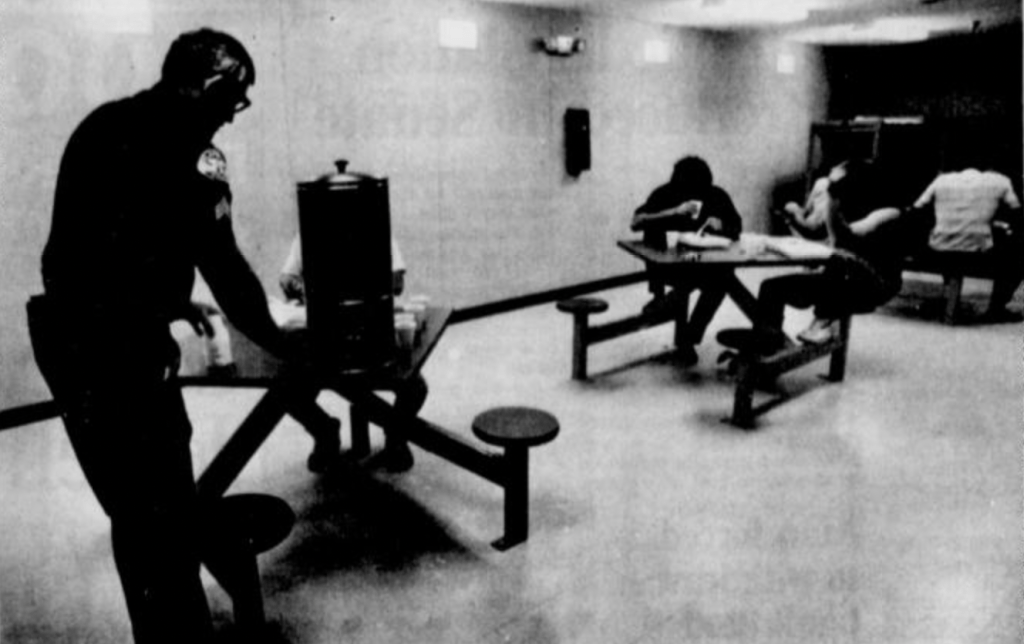
Roughly 19 months after the city jail was effectively condemned, the temporary facility opened its doors in April 1991, over a month and half behind schedule. Thompson said that his officers were “liking and enjoying putting people in jail,” though he noted they generally “don’t like to have to arrest anybody.” Police said they executed 152 arrest warrants in the facility’s first day of operation, collecting almost $2,000 in fines.
“Police came to my door and told me I had to go to jail. I didn’t have the money to pay a fine, so here I am,” said Tim Anderson, a Florence resident who was hauled in on a traffic violation.
Meanwhile, the Lauderdale County Jail was grappling with its own set of challenges. A two-day riot — during which inmates burned plastic serving trays, destroyed furniture, and ripped down light fixtures — resulted in $30,000 of damage that the sheriff’s department could not afford to cover, forcing the county commission to approve an influx of additional funds. At the same time, the county was in the midst of a legal battle over the state’s non-compliance with the 1982 federal court order limiting the jail’s maximum occupancy and requiring state prisoners to be transferred to state-run facilities within 30 days of conviction.
A state inspection of the county jail in 1990 found numerous violations at the facility, including cluttered cells and prisoners sleeping on the floor along with fire code violations — issues county officials blamed on the state’s non-compliance with the federal court order. Probate Judge Bill Hanbery, who was tasked with overseeing the county jail, said that as of February 27, 1991, approximately 20 of the 58 prisoners being housed in the facility were state prisoners who were supposed to be held in the state prison system.
“We just want them out because we have a severe overcrowding problem in our jail,” Hanbery said.
Alabama Department of Corrections officials were quick to admit that their practice of housing state prisoners in county jails did indeed constitute a violation of federal guidelines, but asserted that they were unable to comply. According to Debbie Herbert, a spokeswoman for the state prison system, the Alabama Department of Corrections had “over 1,000 inmates in county jails statewide.” The state claimed that Lauderdale County’s overcrowding issue, while a legitimate concern, was not as pressing as the situation in other counties such as Jefferson, Montgomery, and Mobile.
“At this point, there’s nothing we can do,” Herbert said. “We’d like to clear (state prisoners out of county jails), but we can’t. We have nowhere to put them.”
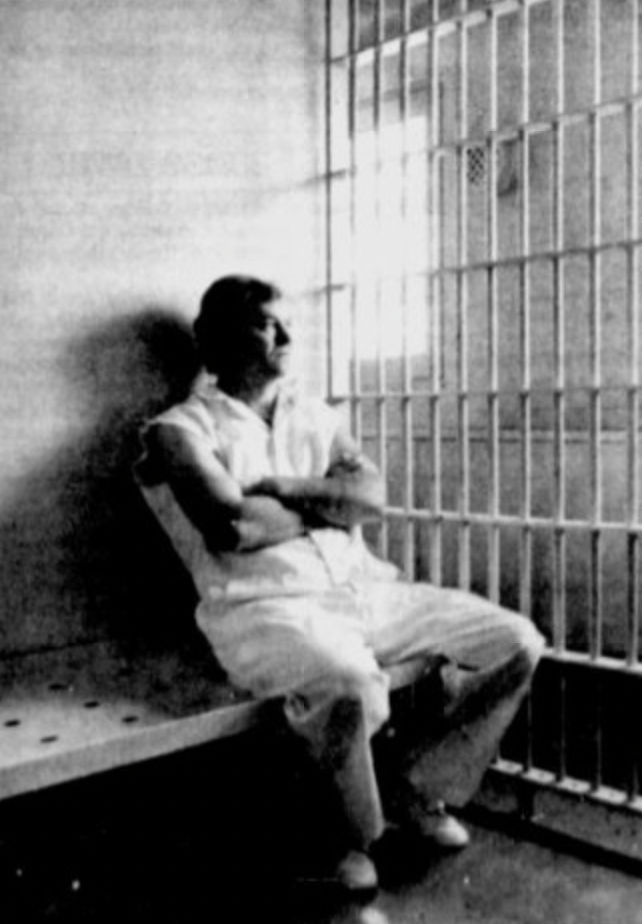
Despite the state’s efforts to avoid taking responsibility, on March 18, 1991, U.S. District Court Judge J. Foy Guin found the state in contempt and ordered the Department of Corrections to remove all state prisoners who have been in the Lauderdale County Jail for more than 30 days after their conviction. In his order, Guin gave the state 10 days to transfer their inmates to state facilities and also ordered that they reimburse the county for any medical expenses those inmates incurred after the 30-day limit. If the state failed to comply with the directive within the prescribed time frame, Guin would fine them $1,000 a day for each inmate remaining in the county jail.
“Since the ruling by Judge Guin, the state will be accepting medical expenses for its prisoners,” Lauderdale County Sheriff Bill Townsend said. “The court ruling should help us. We may be able to cut the budget next year.”
Townsend’s hypothesis proved correct — a month after Guin held the state in contempt, a state inspection of the county jail in April 1991 found the facility was not overcrowded, housing only three inmates more than the court-mandated capacity of 42 prisoners. Unfortunately, the respite afforded to the historically overburdened jail appeared to be temporary. Alabama’s state corrections budget was slashed by $6.9 million in 1992 in the wake of massive spending cuts. As a result, prison commissioner Morris Thigpen ordered the closure of one of the prisons in Barbour County and fired 300 department employees.
“It is not possible for us to continue to provide adequate security and supervision of the available beds currently in our system,” Thigpen said in a letter to Alabama’s 67 county sheriffs, ordering them to stop sending his department state inmates being housed in their facilities. In response to the decision, a number of county sheriffs launched a class-action lawsuit against Thigpen, which resulted in a circuit court imposing a temporary injunction against the state’s moratorium on inmate transfers. The injunction was later upheld, forcing Thigpen to ask the governor to exempt his department from proration.
Amidst the raging legal battle over the moratorium, the situation inside the Lauderdale County Jail was equally as contentious. Two inmates, Terrell Brown and Edward Kennedy, brutally assaulted another prisoner by shoving the handle of a broom down the throat of another inmate after he allegedly used a racial slur. The victim, 39-year-old Hoyt McGee Jr., was hospitalized for 20 days as a result and the perpetrators were each ordered to pay $59,000 to reimburse the county for McGee’s medical expenses.
In 1996, both the city of Florence and Lauderdale county were hit with a $300,000 claim after an inmate alleged he was assaulted while in custody at the Lauderdale County Jail. According to the former inmate, Shannon White, he was taken into custody by Florence police on October 23, 1994 in connection with an ongoing burglary investigation. White claimed that he was not informed of his constitutional rights and, as a result, left the building as he did not believe he was under arrest. He further asserted that after he left, rather than attempting to call White back into the building, Florence police sent their dogs after him.
White said he was attacked and bitten by the police dogs, sustaining injuries as a result. He was then taken to the Lauderdale County Jail, where he claims deputies refused to give him his prescription medication and denied him bandages for his wounds. White claimed that jail staff also failed to take him to a scheduled follow-up appointment.
City and county representatives refused to comment on the allegations, but stated that their insurance company would assess the claims and ascertain whether or not the evidence warranted a settlement with White.
Less than two months after being hit with White’s claim, former Florence Police Chief Rick Thompson was hauled into federal court to face two counts of civil rights violations. He had been placed on leave several years prior after an internal investigation revealed he violated department regulations after he fired his pistol into the air as he was trying to apprehend a fleeing suspect.
According to reports, both Thompson and the Florence Police Department had been the subject of a months-long probe launched by state investigators and the FBI into allegations of corruption and civil rights violations in the department. The city requested the assistance of the FBI after they discovered that furniture donated to the city had been falsely reported as stolen on an insurance claim. In a supplement to the theft report obtained by the TimesDaily, Thompson was identified as the “suspect” in the case.
Rick Singleton, the current Lauderdale County Sheriff, was appointed as interim police chief following Thompson’s resignation, a position which was later made permanent. Although making a false report to law enforcement is a misdemeanor, Singleton refused to bring charges against his former boss.
“I am very surprised, shocked and disappointed in the conclusion of this internal investigation,” Singleton said. “The facts speak for themselves.”
Thompson pleaded guilty to violating the civil rights of two suspects in the October 1991 robbery of the Moody Drug Store. During the incident, which occurred after the suspects were taken into custody, he pretended to shoot both suspects in the head — holding a loaded gun that had the gunpowder removed to the suspects’ heads and pulling the trigger. He was sentenced to 18 months’ probation and placed on “home detention.”
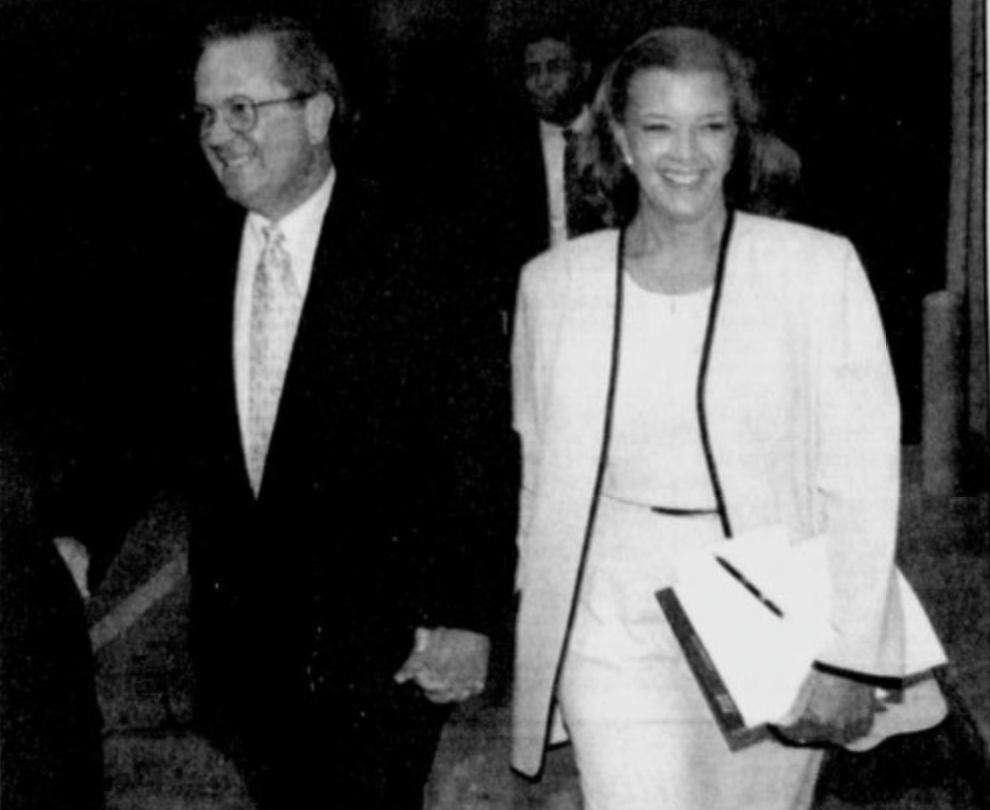
The light sentence was generally condemned by Florence residents, who believed the former police chief received special treatment due to his position. A retired employee of the Florence Detention Center who worked with Thompson remarked that Thompson himself “arrested a lot of people off this very street and put them in prison for a long time for doing a whole lot less than what he did.”
After his colleague’s sentencing hearing, Singleton expressed support for the disgraced former sheriff.
“I’m sure that Rick and [his wife] Janie and their families are glad this is finally over,” Singleton said. “We’re glad this chapter in the department’s history is finally closed and we’re looking forward to the future.”
Singleton’s attempt at quashing the backlash over Thompson’s conviction was the first of many scandals that would cloud his years as Florence’s police chief. Constrained by a limited budget, the department struggled to retain qualified officers due to competition with state and federal law enforcement agencies which offered recruits higher salaries.
“It’s been a problem for as long as I can remember to have a larger agency … come in and hire officers from your department,” Singleton told a reporter in 2000.
Despite being the largest police force in the Shoals area, with 93 officers, the Florence Police Department was not immune to high turnover and understaffing. In an attempt to remedy the retention problem, the department focused its recruiting efforts on colleges with criminal justice programs, preferring to train new officers rather than poach experienced officers from smaller police departments, though this appeared to do little to rectify the issue.
By 2002, the department was short eight officers, which was nearly the equivalent of one patrol shift. Even with the return of three officers from medical leave that year, the department was still grappling with staffing issues. Whether the result of officers taking military leave, being out sick, or on vacation, “we are never at full force for one reason or another,” Singleton said. Within the first three months of 2002, the department had already used up 71 percent of their $158,000 overtime budget, prompting City Councilman Sam Pendleton to push for the addition of another 15 officers to the force.
In 2005, Florence Police Capt. Spence Butler, a 16-year veteran of the department, resigned after four women — three of whom were city employees — alleged he engaged in sexual misconduct towards them.
A lawsuit filed by one of the women against Butler, Singleton, and the city of Florence alleged that she was subjected to sexual harassment ever since she began her employment with the Florence Police Department. She claimed that Butler, who was her supervisor, sexually assaulted her inside the police department in 2004 and indecently exposed himself to her.
According to the plaintiff, Singleton fostered a hostile work environment which resulted in the minimization or outright dismissal of her complaints against Butler. The woman’s attorney, Jamy Poss, said that “basically, what (Singleton) did was create a work environment where sexual harassment would grow.”
Singleton was separately accused of covering up misconduct by his officers by local resident Steve Modus, and the case went to a grand jury. Although Singleton was cleared by that grand jury, Butler was indicted on a charge of perjury after he was accused of lying during his testimony. Butler was later found not guilty of the charge.
Jackie Rikard, the administrator of the Florence City Jail, also decried the male-dominated work culture as detrimental to the facility’s effectiveness, explaining that even after nine years on the job she still had to “fight the good-old-boy syndrome and the we’ve-always-done-it-that-way syndrome.”
In 2006, another longtime officer with the department was charged in a child pornography investigation. Capt. Basil Kenny “Ken” Stanley was charged with using both home and office computers to send and receive images of “children engaging in explicit sexual conduct.” He pled guilty to the charges.
As the Lauderdale County sheriff, Singleton had an equally abysmal record. He inherited a facility with massive operational security issues spanning back decades. Even the opening of the new $5.6 million Florence-Lauderdale Detention Center did little to resolve the problems which in preceding years had been blamed on the inadequate physical infrastructure in the old facility.

Jailers mistakenly released Robert Eric Williams, a 22-year-old man suspected in two attempted murder cases, in 2002. Police investigators speculated that the jail staff thought that investigators were finished with Williams after they returned him to his cell following questioning and released him.
The mishap set off a month-long manhunt for the suspect, who had previously held a gun to an acquaintance’s head when he was released on bond the month prior on the first attempted murder charge. Unable to locate Williams, the Florence Police Department requested the assistance of the FBI in apprehending the fugitive. After an FBI agent based in Florence received a tip as to Williams’ whereabouts, local officers were able to locate and arrest Williams without incident.
“Hopefully, the jailers will keep him in jail this time,” Florence police investigator Jeff Redcross said after Williams was back in custody. “In my personal opinion, he is a danger to society, and we need to keep him in jail until his trial date.”
Even when prisoners were successfully kept behind bars, mishandled evidence and shoddy record-keeping provided cannon fodder for defense attorneys.
Both the sheriff’s office and the district attorney’s office came under fire for their handling of the capital murder case against Donald Wayne Darling. Defense attorneys claimed that crucial evidence was illegally withheld by the prosecution before trial, including an axe handle that was found in investigator Ronnie Willis’ office.
Willis, who became the county sheriff in late 2003, stated that the axe handle was brought to him after the murder but deemed it to be irrelevant in the case against Darling, since the victim, Wilburn May Jr., had been shot, not beaten. A mistrial was declared in the case and, despite Willis’ claim, the State Supreme Court upheld the State Court of Criminal Appeals’ ruling that the Darling should be retried.
After taking office as county sheriff, Willis sought to implement new measures to restore the integrity of the department. Prior to Willis’ tenure, evidence was stored in an area of the building that all officers had keys to access. As sheriff, Willis created a secure evidence room that only the newly-hired evidence technician and chief investigator were given keys to.
In July 2004, a jury acquitted Larry Wayne Brandon, who was confessed to shooting a man in the back during a fight in rural Lauderdale County. Brandon’s attorneys successfully sowed the seeds of reasonable doubt within the minds of jury members after they pressed sheriff’s investigators for not having a crime scene video or photos. When questioned in court, the investigators admitted they could not even identify the person who took the photos they did have.
A lack of oversight also contributed to instances of brutality inside the facility, including an incident where a corrections officer beat an inmate’s head against a cement wall in 2005. After Kris Thornton was brought to the Lauderdale County Detention Center following his arrest on a DUI charge, he filed grievances against Philip King, a supervisor at the jail. According to Thornton’s attorney, King attacked the inmate in retaliation.
“King charged him,” said Thornton’s attorney, Henry Sherrod III. “He grabbed him around the throat, pushed him down on his metal bunk, and banged his head against the concrete wall approximately six times.”
Thornton had to be transported to a nearby emergency room for medical treatment after the attack, and claimed to have suffered from facial paralysis as well as nose bleeds and double vision. Thornton was awarded $20,000 in damages after he won a federal lawsuit against the facility in 2009.
Although the Lauderdale County Jail appeared to have decreased the number of inmates who escaped from the facility in the 2000s, a number of inmates facing serious charges managed to break out of the jail in the following decade.
In early October 2012, four men––Wesley Lee Gibson, Damien Lee Nix, Ricky Dewayne Lawson, and Robert Lee Brown––escaped by reportedly climbing through an air-conditioning duct to reach the roof of the jail before hopping a fence. Lawson’s father, Ernest Earl Lawson, lent his son, Brown, and Gibson his red truck to aid in their escape. He also provided them with money.
Nix was arrested the following day inside a residence on East Limestone Street in Florence, according to Sheriff Willis. Gibson evidently managed to create more distance between himself and the facility––he was apprehended in a church in Navarre, FL, southeast of Pensacola. The red truck belonging to Lawson’s father was found in the parking lot of a nearby Wal-Mart.
“From what we’ve been able to determine, [Gibson] was caught inside the church, apparently trying to steal the keys to a church vehicle,” Willis said.
Lawson and Brown were arrested four days after the escape in Evergreen, AL, almost 300 miles south of Florence. All four of the men faced an additional charge of second-degree escape, though Travis Clemmons, chief investigator with the Sheriff’s Office, noted that those charges could be upgraded.
“Right now it’s second-degree escape; that could be updated by the grand jury once the cases are presented,” Clemmons said.
Things did not improve when Rick Singleton took over as sheriff in 2013. Although fencing fitted with razor wire was installed around the jail in June of that year, the facility was evidently no more secure than it had been in the decades prior, mainly due to incompetent and corrupt staff.
Michael Prater, an inmate at the Lauderdale County Jail, was mistakenly released on March 19, 2015 due to a clerical error, prompting an internal investigation. He had been transferred to the jail from the Fountain Correctional Facility in Escambia County for sentencing on a felony escape charge, and was sentenced to 15 years in prison on March 13. Despite having been sentenced over a week ago, Singleton said at the time that the prisoner was allowed to leave the facility because to the deputy who let him go did not receive updated sentence information.
Kenneth Lee Lawson, who was employed as a guard at the jail, was arrested in 2016 during a shift change after it was discovered that he was smuggling drugs into the facility. Lawson’s fellow officers found Suboxone, the prescription narcotic, hidden inside Lawson’s Bible. According to Singleton, upon his arrest, Lawson was also found to have tobacco in his possession and was charged with attempting to bring contraband into the jail.
Another guard, 21-year-old Brandon Pate, was also arrested four months later on similar charges.
“We had some information that this stuff was going to be coming into the jail,” Singleton said. “We looked into it and determined he probably would be the one delivering it.”
Officers searched Pate when he arrived for his shift the following night and found rolling papers, loose tobacco, and a phone charger in his possession. Singleton blamed the actions of both guards on the measly salaries afforded to jail staff, citing their vulnerability to bribes.
“I think in our case part of the problem is we only pay these guys like $24,000 per year starting out,” Singleton explained. “So when an inmate’s family offers them $20 or $50 or $100 to smuggle in a cellphone, that’s the only motivation I can think they have to violate the law.”
On April 8, 2017, 43-year-old Christopher Wayne Kilpatrick––who had recently been indicted on charges of attempted murder of a police officer, first-degree theft of property, second-degree theft of property, and breaking and entering a motor vehicle––escaped from the county jail while he was awaiting trial. Despite the newly-installed razor wire fence surrounding the facility, Kilpatrick escaped in the exact same manner as Gibson, Nix, Lawson, and Brown back in 2012.
According to Singleton, Kilpatrick crawled through a casing around a plumbing pipe and got onto the roof of the facility before climbing over the razor wire. He then proceeded to steal 2003 maroon Chrysler Town and Country van shortly after breaking out of the jail.
“The damage that was done for this inmate to get on the roof was repaired, but Mr. Kilpatrick was able to go through that process and able to get out the same way,” Singleton conceded.
The fugitive was apprehended a week later following a standoff with deputies, who had to close down a portion of Highway 157 while police negotiated with Kilpatrick, who was holed up in a nearby building. He surrendered peacefully.
On December 17 of the same year, Kilpatrick would escape the facility once again using the same method he used back in April. Deputies in Macon County, GA responded to multiple reports of a vehicle driving erratically on December 18 in Red Boiling Springs.
“Detective Donnie Crawford observed the vehicle traveling on Highway 52 East near Coleytown Market,” Macon County Sheriff Mark Gammons stated. “The vehicle was a green, Dodge Dakota with Alabama tags. When Detective Crawford ran the tags, it was confirmed that the vehicle was reported stolen in Alabama. The vehicle continued traveling recklessly towards Red Boiling Springs, almost hitting another vehicle head on.”
Officers attempted to get the driver to stop, but he sped up, almost sideswiping a patrol car before crashing into a ditch. Red Boiling Springs Police Chief Kevin Woodard directed the driver to exit the vehicle with his hands up, but the driver, who was later identified as Kilpatrick, began to reach behind the driver’s seat, at which point Woodard deployed his taser.
“It appeared that Mr. Kilpatrick had alcohol in his system and was possibly under the influence of methamphetamine at the time of his arrest here in Macon County,” said Sheriff Gammons.
Kilpatrick was then taken into custody in Macon County while awaiting extradition back to Alabama.
In contrast to Kilpatrick’s escape, inmate Casey White had no need to crawl through the walls of the Lauderdale County Jail––he meandered his way into the back of a patrol car driven by Assistant Director of Corrections Vicky White. Casey White’s escape was not the result of defects in the facility’s physical infrastructure, but rather an exploitation of the jail’s poor management and lack of oversight.
Rather than take accountability for the misconduct of his subordinates, it appears that Sheriff Singleton has resorted to his long-standing pattern of blaming others for systemic failures that occur under his watch. Although he himself conceded that Vicky and Casey had a “special relationship,” Singleton admits that it was not until he spoke with other inmates at the jail that he became aware of any unusual relationship between the two.
“The contact I am aware of is the special treatment he got while he was here. Seeing he had extra food and other things that inmates don’t normally have,” Singleton said.
Despite having cameras throughout the jail, it seems that no other member of the staff noticed the “special treatment” Vicky was affording the inmate facing a capital murder charge. Additionally, it appears that none of her subordinates thought to question Vicky as to why she was breaking the two-officer escort protocol to take Casey White to his unverified “mental health appointment.”
Although Vicky White orchestrated and participated in the escape of Casey White, mismanagement and a lack oversight in the facility made her job easy.
 Katie Smith
Leave a comment